Peer Review Process

Manuscripts submitted to the Journal of Quranic Teaching and Learning must be uploaded through the official submission system, where they will first be screened by the Managing Editor. Each manuscript will then undergo a rigorous peer review process using a (double-blind review). Only manuscripts that have undergone a thorough evaluation and received approval from reviewers consisting of at least two specialists in the relevant field of study will be considered for publication. This procedure ensures the academic integrity, quality, and credibility of all articles accepted by the journal.

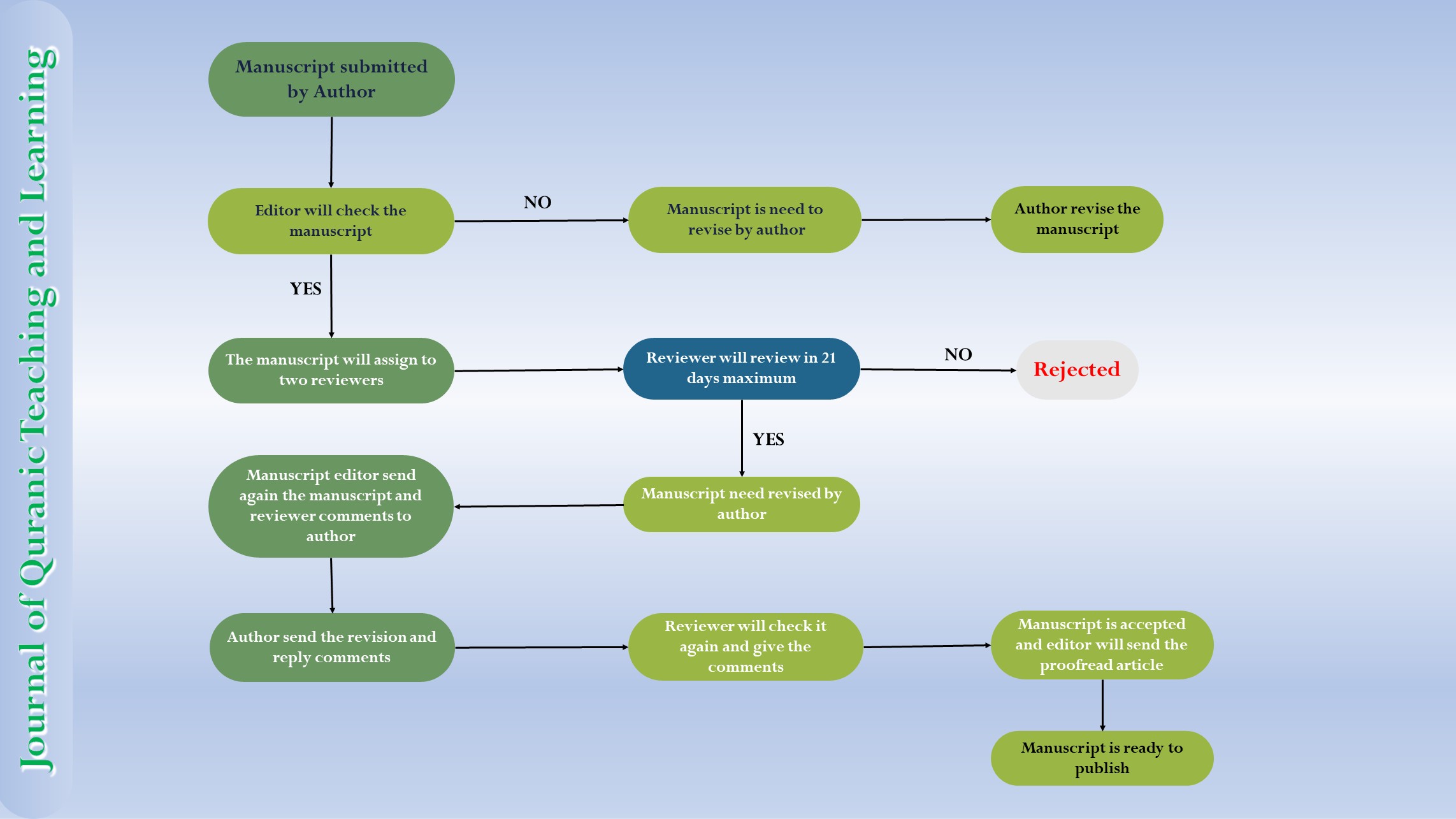
The steps of the review process are outlined in the following diagram and description.

1. Manuscript Submitted by Author

The peer review process begins when the author submits the manuscript to the editorial system. At this stage, the paper must comply with the conference or journal’s submission guidelines, including formatting, referencing style, and content relevance. Proper submission marks the official entry of the manuscript into the review workflow.

2. Editorial Screening

Once the manuscript is submitted, the editor conducts an initial assessment to verify the completeness, quality, and suitability of the paper. The editor checks whether the manuscript aligns with the journal’s scope, follows the submission format, and meets the language and ethical standards required for publication. This step ensures that only qualified manuscripts proceed to the review stage.

3. Manuscript Revision Before Review

If the manuscript does not meet the basic editorial standards, it is returned to the author for revision. The author must revise the manuscript according to the editor’s feedback, which may include corrections to formatting, language quality, and the overall structure of the paper. Once the necessary revisions are made, the manuscript is resubmitted for further consideration.

4. Assignment to Reviewers

After passing the initial editorial screening, the manuscript is assigned to two independent reviewers who are experts in the relevant field. These reviewers are selected based on their academic expertise and research background to ensure an objective and qualified evaluation of the paper.

5. Peer Review Process

The assigned reviewers examine the manuscript carefully within a maximum period of 21 days. During this stage, reviewers evaluate the originality, scientific quality, methodology, and contribution of the manuscript to the field. They also provide detailed feedback and recommendations for improvement.

6. Rejection Decision

If the reviewers find that the manuscript does not meet the required scientific standards or contains significant flaws that cannot be corrected through revision, the editor may decide to reject the paper. This decision is based on the reviewers’ reports and the overall quality of the research presented.

7. Manuscript Revision After Review

In cases where the reviewers suggest revisions, the manuscript is returned to the author for modification. The editor sends both the manuscript and the reviewers’ comments to the author. The author is required to revise the manuscript thoroughly and provide a “response to reviewers,” detailing how each comment was addressed.

8. Secondary Review

Once the revised manuscript is resubmitted, it is sent back to the reviewers for another round of evaluation. The reviewers check whether the author has adequately responded to their comments and whether the revised version has improved in quality and clarity. This iterative process continues until the reviewers and editor are satisfied with the manuscript.

9. Manuscript Acceptance

When the reviewers and editor determine that the manuscript meets all publication standards, it is formally accepted. At this stage, the editor may perform minor editorial adjustments and initiate the proofreading process to ensure the manuscript is free of typographical or grammatical errors.

10. Publication Preparation

The final stage involves proofreading and layout checking by the editorial team. After the manuscript passes these final quality checks, it is prepared for publication. The completed and approved manuscript is then scheduled for release, marking the end of the peer review process.